

Intaglio Printmaking: Insights from My Two-Day Workshop

Intaglio is a form of printmaking that combines precision, patience, and creativity. Recently, I had the opportunity to attend a two-day Intaglio printmaking workshop at Centrespace studios in Bristol, led by master printmakers Jemma Gunning and Ian Chamberlain. This experience opened my eyes to the intricate techniques and rich history behind Intaglio, as well as the hands-on skills needed to create stunning prints.

Creating an image on copper
Intaglio is a printmaking technique where the image is incised into a surface, usually a metal plate. Throughout the weekend we used copper, which is largely considered the most preferable metal due to its ability to hold fine detail and its durability. The copper is exposed to acid (Ferric Chloride) which incises the surface of the plate. The incisions hold the ink, and when paper is pressed onto the plate, the ink transfers to create the print. This method contrasts with relief printing, where the raised surface is inked - so the opposite of what I'm used to with linocutting.
Throughout the weekend we used the following processes to create an image on the copper.
Hardground etching
Aquatint
Spit bite
Sugar lift
Each process masks areas of the plate in a different manner, allowing control over how long each areas is exposed to the acid. The longer any given area of the plate is exposed to the acid, the deeper the incisions will be and therefore the more ink they will hold causing a darker area on the final print. The result is a print with rich textures and fine details.
Inking and printing
Applying the ink was an art in itself! Traditional oil based etching ink was spread over the plate making sure it filled the incisions. Then it was a case of carefully removing excess ink from the plate’s surface without disturbing the ink in the grooves. Seeing the first print emerge was thrilling. I learnt that the amount you wipe from the plate can make a huge difference to your final print - even though the plate appears clean, the paper can pick up the tiniest traces of ink, so you can take advantage of this and create different monoprint-style effects, or almost polish the plate if you're wanting areas to come out a bright white.
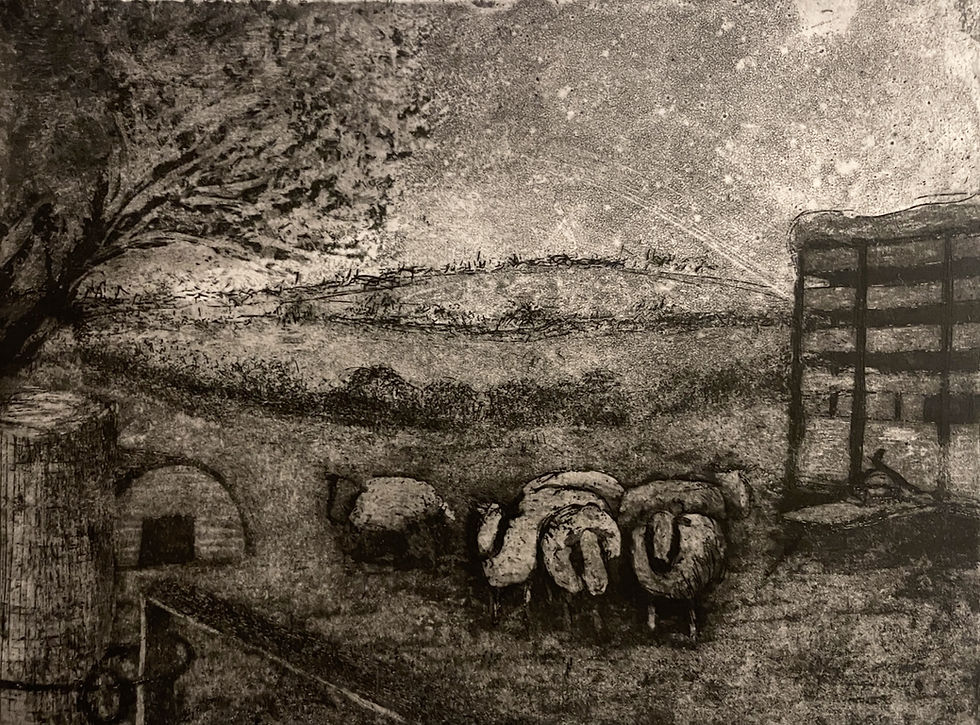
My final print - not exactly a masterpiece but I learnt so much!
Final Thoughts/Highlights
Patience is essential: Intaglio requires careful preparation and slow, deliberate actions.
Don't be limited by traditional artists' tools: Trying different tools and methods revealed unexpected textures and effects. Sandpaper worked really well to create texture, an a tattooing needle was also very useful.
The tactile nature of printmaking: Feeling the metal plate, the ink, and the paper creates a strong connection to the art.
Learning is fun: What a joy to learn something new! Jemma and Ian were hugely generous with their knowledge and expertise, and ever patient with me as a complete beginner to these techniques. It was wonderful to be in such a fabulous creative space with the other attendees who were all knowledgable and talented in their own right.
I'm not sure where this will take me - I don't have the space or funds for a lot of the equipment and materials necessary - but I very much enjoyed learning for learning's sake, and I can't wait to do something similar again soon.


Comments